
Category
Gap Year Program




Category
Gap Year Program 
 Bachelor of Finance & Artificial Intelligence Bachelor of Management & Technology Integrated Bachelors and Masters in Management & Technology Graduate Program in Entrepreneurial Leadership Integrated Bachelors and Masters in Management & Technology Tetr Pathfinder: China Edition Tetr Pathfinder: Europe Edition Tetr 7-day Basecamp Student Life Contact Us Jobs


Table of Contents
An analysis of the five mistakes to avoid when choosing a business school abroad.
Choosing the right business school abroad can shape how you understand markets, collaborate with people from different backgrounds, and apply ideas to real business problems before entering professional life.
Finding the right learning environment is not always easy. When studying business abroad, students must compare unfamiliar institutions, countries, learning models, and costs. Since brochures can make many options appear similar, avoiding these five mistakes will help you understand what each school expects you to learn and experience.
An institution ranking may help create an initial list, but it cannot fully capture the daily learning experience. Its methodology may reward research, reputation, salaries, or selectivity: factors that may not match your priorities. Do not make this mistake.
First, define your intended outcome. Do you want to build ventures, enter a particular industry, or work across markets? Use rankings as one reference, then ask whether the business school supports that aim.
Once you place reputation in context, examine what happens within the curriculum.
Two schools may offer a similar business course, while one relies on lectures and the other focuses on experiential learning by encouraging students to price a product, interview customers, or defend decisions before practitioners. Therefore, a curriculum should show not only what you will study but also what and how you will learn to handle it.
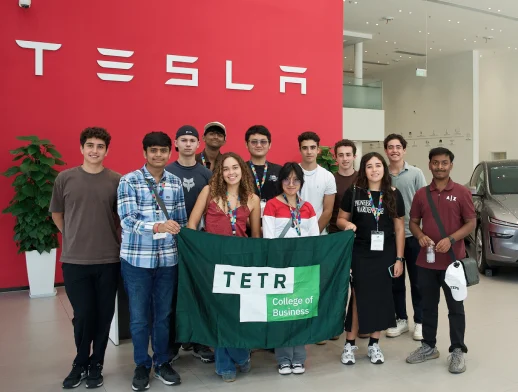
At Tetr College of Business, applied workshops sit alongside venture-building capstone projects in different markets. Students encounter business and technology through work with real constraints for better exposure.
This work gains another dimension when the location changes.
Lists of the best countries to study business often compare visas, costs, employment, and university reputation. These points matter, but each country also presents distinct customers, regulations, industries, and working cultures.
To make the right choice, ask how the school uses its location to give students the required exposure. At Tetr, we treat countries as classrooms, with students building across different commercial settings rather than experiencing global education as travel alone.
However, adapting to these settings also depends on the people around you.
An international business school should offer more than a diverse admissions page. Examine how often students collaborate across cultures and whether founders, operators, and executives contribute to their learning.
Ask current students about teamwork, mentorship, feedback, and access to practitioners. Their answers often reveal the school’s everyday culture more clearly than formal messaging. This will give you a clearer picture.
The learning experience may feel right, but it must also make financial sense. Do consider the cost of investment while choosing a business school.
Tuition is only one part of studying overseas. But housing, insurance, visas, flights, local transport, and everyday costs add to the expenses. Such extra costs are often overlooked by most students.
Review what each scholarship covers and whether renewal conditions apply. Part-time work may also help offset some living expenses, but first confirm whether the student visa permits employment, the number of hours allowed, and the availability of suitable roles. Any expected earnings should support a financial plan rather than form its foundation.
Finally, consider the return on investment: the qualification, practical experience, professional access, and career support. It’s a more realistic comparison when you consider the total cost and the value provided.
Together, these checks shift the focus from rankings and tuition to the learning experience behind the degree. They also provide a clear basis for considering how Tetr approaches business education.

Choosing an international business school requires bringing these considerations together. Look beyond a headline position and examine the work, markets, people, and costs behind it.
For students drawn to learning business by building businesses across cultures, Tetr College of Business brings together venture creation, global immersion, and technology. Explore our graduate and postgraduate programs to consider whether this learning environment matches the future you want to build.

What are the common mistakes students make when choosing a business school abroad?
Common mistakes include relying only on rankings, overlooking practical work, ignoring school culture, and comparing tuition rather than the complete cost.
How can I compare business schools before applying?
How do I choose the right business school abroad?
How can international students prepare for cultural differences at a business school abroad?
