
Category
Gap Year Program



Category
Gap Year Program 
 Bachelor of Finance & Artificial Intelligence Bachelor of Management & Technology Integrated Bachelors and Masters in Management & Technology Graduate Program in Entrepreneurial Leadership Integrated Bachelors and Masters in Management & Technology Tetr Pathfinder: China Edition Tetr Pathfinder: Europe Edition Tetr 7-day Basecamp Student Life Contact Us Jobs


Table of Contents
An analysis of the entrepreneurial skills that young founders require for a successful business venture.
Every entrepreneur begins with an idea. Few begin with the skills to carry it through. The gap between the two is where most ventures quietly fail: not for lack of ambition, but for lack of the discipline, judgement, and range that building something real demands.
Entrepreneurial skills are not innate talents reserved for a few; they are capabilities built through repeated exposure to ambiguity, failure, and real decision-making. For anyone asking how to become an entrepreneur, the honest answer starts here: with the skills, not only the idea.
A business idea does not progress through inspiration alone. The skills needed to be an entrepreneur support each stage, from examining an opportunity to adapting as the venture enters the market.
Entrepreneurs constantly pitch assumptions to investors, customers, co-founders, and even themselves. The ability to question a business plan before committing resources to it is what separates a founder who pivots early from one who exhausts their options defending a bad idea.
A business plan rarely survives the first contact with a real market. Founders who treat their business strategy as a working draft, not a finished document, are the ones who last long enough to find product-market fit. This skill is a habit best built by actually operating in changing conditions, which is a large part of why Tetr's Graduate Program in Entrepreneurial Leadership moves students across different markets rather than keeping the variables constant.
Reading a balance sheet or a cap table isn't an accounting exercise; it's how founders protect equity, plan runway, and know when a "good" deal is actually a bad one. Skills needed to be an entrepreneur rarely get more foundational than this.
A business idea remains just an idea if the entrepreneur cannot explain it clearly to the target audience. Customers, teammates, suppliers, and investors listen for different things. A founder should adapt the message for each audience while keeping the purpose, value, and expectations around the venture clear.
Every deal, hiring decision, and partnership is a negotiation, whether it's framed as one or not. Founders must know how to negotiate with suppliers, employees, partners, and investors long before a company matures. Preparation helps them protect essential business terms, find workable trade-offs, and step away from an unsuitable agreement.
Setbacks are not exceptions in entrepreneurship; they're the operating condition. What matters is whether a founder treats a failed pitch or a missed milestone as data to act on or as a verdict to accept. Staying resilient helps aspiring founders sustain in a long entrepreneurial journey.
The right relationship, built months before it's needed, often matters more than the right idea. This is one reason Tetr's global programs put students in direct contact with founders, operators, and industry leaders early; relationships built under real stakes tend to hold up better than ones built at a career fair.
Perhaps the most compounding skill of all: the ability to align a team, investors, and early customers around a vision that doesn't yet exist anywhere except in the founder's head. Leadership skills for entrepreneurs involve setting a clear direction without trying to control every task. Good leadership gives students clarity about their role, the confidence to take ownership, and the space to question decisions when needed.
Technology today is less a department and more a decision-making layer across the entire business. Founders don't need to write the code themselves, but they do need to understand what the data is telling them. Tetr College of Business builds this fluency in students by treating business and technology as one discipline rather than two separate tracks.
Markets are no longer local by default. Founders who can read a room in Lagos as well as one in Berlin have a structural advantage over those who've only ever operated in one context, which is precisely what a globally immersive model, of the kind Tetr is built around, is designed to train.
Entrepreneurs rarely get complete information before they need to act. The skill isn't eliminating uncertainty; it's building the judgement to move well despite it and choose a workable course of action. These problem-solving skills in business help founders move forward without waiting for perfect conditions.
Constraints of capital, time, or team size are permanent, not temporary. Founders who manage well within them, rather than waiting for more resources, tend to move faster than better-funded competitors.
None of these entrepreneurial skills develops in isolation. They are best built the way they'll eventually be used: together, under real conditions, which is the premise Tetr's Graduate Program in Entrepreneurial Leadership is designed around.
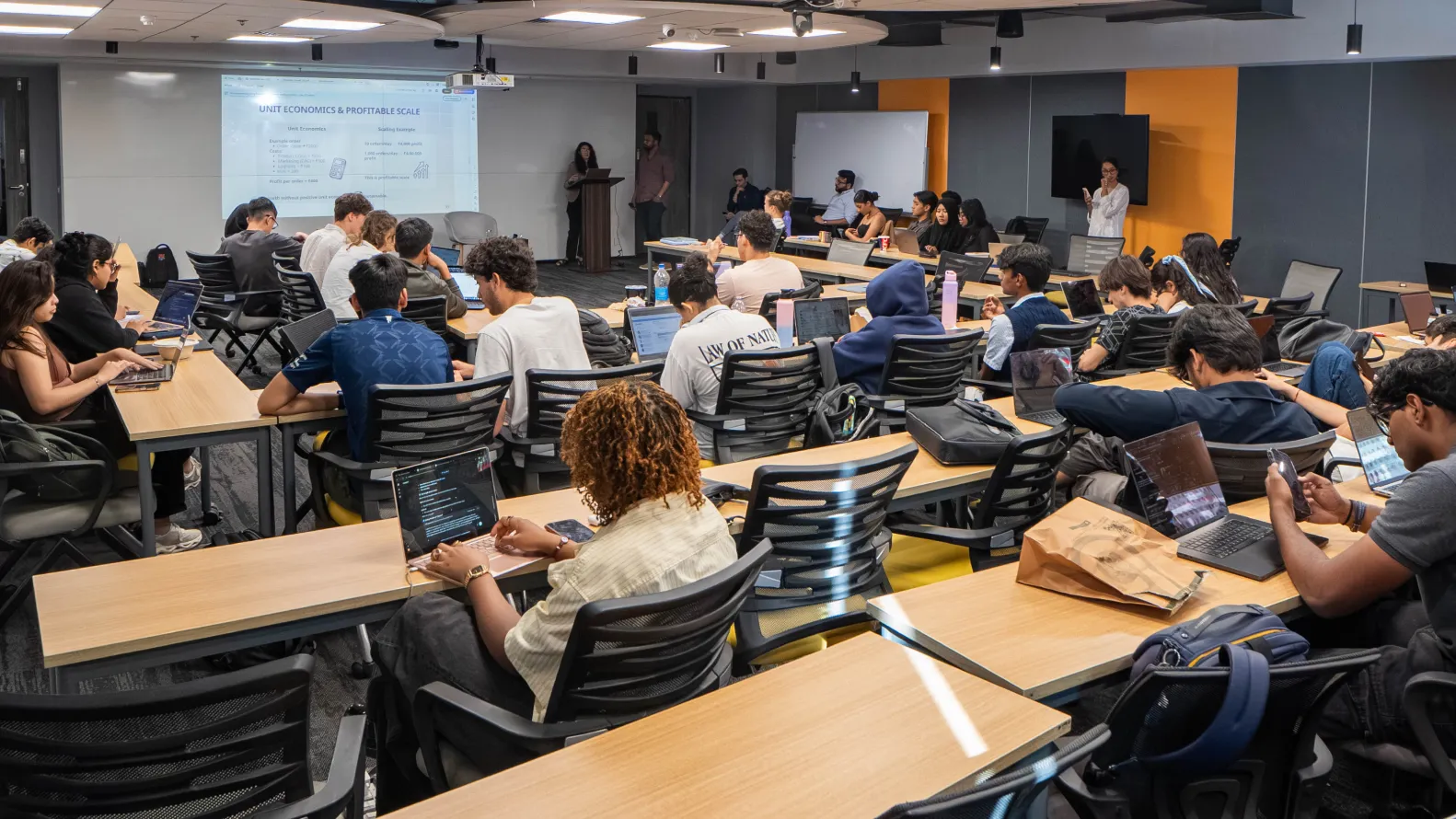
Tetr's year-long Graduate Program in Entrepreneurial Leadership follows one venture across Shanghai, London, and Dubai. In Shanghai, participants turn an idea into an operational product while supplier choices and market validation test their business judgment.
In London, the work turns to brand, capital strategy, and investor expectations. Dubai brings negotiations, partnerships, and market access. Workshops, immersions, mentorship, and team decisions connect each lesson to the venture. At the Pitch Floor, teams present to investors, operators, and industry leaders. Here, entrepreneurship skills for students become visible in how participants explain their decisions and respond to questions about the venture.
Aspiring entrepreneurs do not need every answer before they begin. They need critical thinking and financial judgment to assess evidence, communication and leadership skills to align people, and adaptability to make decisions under uncertainty.
Explore Tetr’s Graduate Program in Entrepreneurial Leadership to learn how building a real business venture can help students develop these entrepreneurial skills through practice.

What are the most important skills for an entrepreneur?
Entrepreneurs need problem-solving, financial management, communication, leadership, adaptability, and decision-making skills to build and manage a business.
Why are entrepreneurial skills important for business success?
How can students develop entrepreneurial skills?
