
Category
Gap Year Program



Category
Gap Year Program 
 Bachelor of Finance & Artificial Intelligence Bachelor of Management & Technology Integrated Bachelors and Masters in Management & Technology Graduate Program in Entrepreneurial Leadership Integrated Bachelors and Masters in Management & Technology Tetr Pathfinder: China Edition Tetr Pathfinder: Europe Edition Tetr 7-day Basecamp Student Life Contact Us Jobs


Table of Contents
Learn how to identify and evaluate profitable business opportunities in your market.
A student may notice that small food businesses in one city struggle with delivery. Elsewhere, delivery may work well, but local sellers find it hard to reach customers online. Either problem could inspire a business, but only if enough people need it and are willing to pay for a solution.
This is why the market is important in learning how to find business opportunities. Aspiring founders need to learn how to build businesses in different markets with different customers and how to figure out if an idea solves a real problem.
But first, founders have to discover a problem that existing business products or services left unresolved.

Many small business ideas begin with a task that’s too slow, expensive, or hard. Before thinking about a product, observe where people face challenges.
Look for these signs:
Customer reviews that repeat the same complaint
Business tasks that require several separate services
Customer groups that current businesses overlook
Products people change to suit their needs
Problems created by changes in technology, rules, or work habits
Students in Tetr’s Graduate Program in Entrepreneurial Leadership learn to identify these problems. They study markets and work on projects in different countries. It helps them to understand how customer needs vary from one place to another.
But finding a problem is only the beginning. Business opportunity identification also requires evidence that the problem affects the audience and needs a better solution.
Good market research for startups combines reports with direct customer research. These reports show the size of an industry, while interviews and observation reveal how people manage the problem today.
|
What to Examine? |
Questions to Ask |
What Does It Reveal? |
|
Customer Need |
Who faces the problem, and how often? |
How common and urgent it is |
|
Current Options |
What do customers use now? |
Competitors and missing solutions |
|
Spending |
What do customers already pay? |
A possible price range |
|
Buying Habits |
Where do customers search and buy? |
Suitable sales channels |
|
Delivery |
What is needed to complete each sale? |
Time, people, and resources required |
This research shows which small business ideas respond to lasting customer demand. Positive feedback is useful, but only actual buying behaviour shows interest.
Once the research shows genuine interest, the business idea should be tested on a small scale.
Learning how to start a business does not require a complete product. Begin with a preorder, prototype, small batch, limited service, or landing page.
While conducting a test, get answers to these questions:
Will the intended customers pay for the product offering?
Can the business deliver the product at a consistent standard?
What can be improved before the next test?
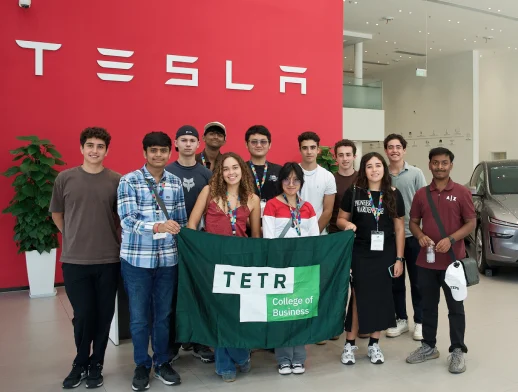
These insights can help businesses launch their products successfully and create a strong industry presence over time. Tetr’s Graduate Program in Entrepreneurial Leadership follows this process across three markets. Participants validate a product in Shanghai, work on brand and capital strategy in London, and explore partnerships in Dubai. In each market, they decide what business idea to keep and what to change.
Customer interest is encouraging, but it does not prove that the business will keep on making money. Founders should also check whether the business can earn a profit.
A business can make sales and still lose money. Profitable business ideas must bring in enough revenue to cover the cost of serving each customer. To check whether the numbers work, calculate:
Selling price
Product cost
Advertising expenses
Operating costs
Repeat sales
Also consider what happens if supplier prices rise or customers take longer to return. The numbers may point to a different price, customer segment, sales channel, or delivery method, indicating that the business idea is not ready for the market. Early insights can help founders save time and money.
Founders decide if an opportunity is worth pursuing by looking at customer needs, market response, and costs together.
A great idea becomes a business opportunity only after the need is validated by customers and the profit numbers back the solution. During business opportunity identification, research, testing, and revision help founders move forward with evidence rather than assumptions. This becomes especially important across markets, where customer habits, costs, and sales channels can change.
Explore Tetr’s graduate and postgraduate programs to learn how building ventures across countries can help you develop the judgment to identify opportunities and shape them into viable business projects.

What factors should I consider when evaluating a business opportunity?
Consider customer needs, market research, operating needs, profit margins, and the possibility of repeat purchases to turn a business idea into a viable opportunity.
How can I identify gaps in the market for a new business?
