
Category
Gap Year Program
Category
Gap Year Program 
 Bachelor of Finance & Artificial Intelligence Bachelor of Management & Technology Integrated Bachelors and Masters in Management & Technology Graduate Program in Entrepreneurial Leadership Integrated Bachelors and Masters in Management & Technology Tetr Pathfinder: China Edition Tetr Pathfinder: Europe Edition Tetr 7-day Basecamp Student Life Contact Us Jobs


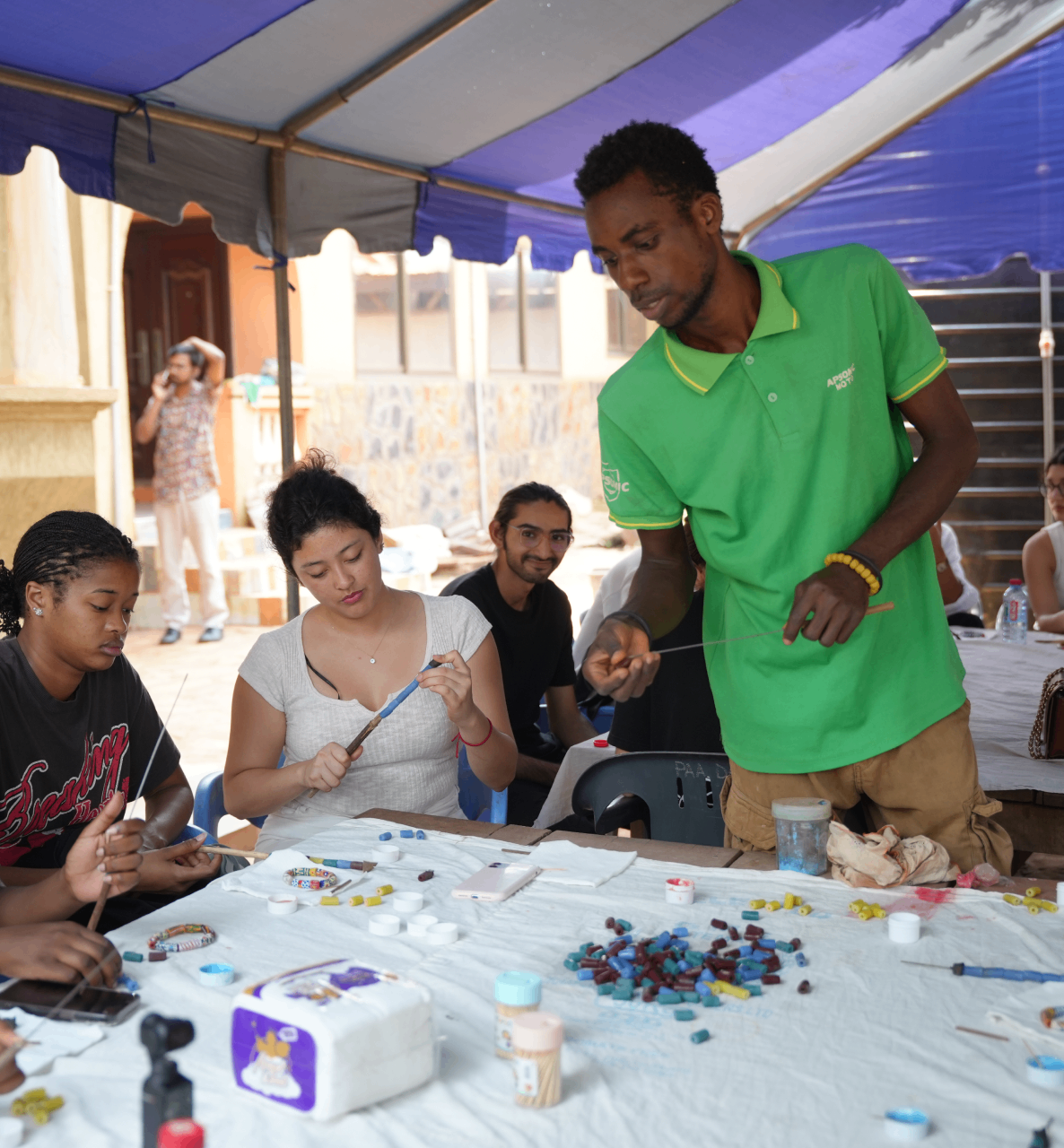
Table of Contents
Recently, Tetr students sat down with one of Ghana's oldest living industries. A bead-making workshop in Jamestown that has been turning recycled glass into cultural artefacts for generations.
In doing so, they quietly built one of the most honest business models the students ever encountered.
Long before branding became a discipline, Ghanaian communities were already doing it.
In Ghana, beadmaking is one of its purest expressions. It’s timeless, rooted, and impossible to modernise away. Among the Krobo people, beads mark Dipo, the rite of passage into adulthood. In Ashanti culture, they signal royalty and status. In Ewe tradition, they represent femininity, beauty, and life milestones. Symbolism has always been at the heart of the world's most enduring cultures.
And from a business perspective, what makes it remarkable is not just that it has survived. It has never stopped being relevant.
The value was never created by modern markets. It was always there. The story, the meaning, the demand. What the world is only now catching up to is that cultural authenticity is not niche.
It’s leverage.
The session began with the full journey of a bead, from recycled glass and raw materials through to the finished pieces sold in local markets and exported globally.
The students learned the techniques, understood the process, and then applied them, designing, decorating, and assembling their own bracelets from scratch.
What they walked away with was more than a bracelet. It was the kind of understanding that only comes from holding both the raw material and the finished piece, and reckoning with everything that lies between. Not machinery. Not systems. People. Skill. Precision. Repetition. Story.
Before leaving, students spent time at the workshop's Curio Shop, where finished beadwork sat on shelves waiting for local buyers and international markets alike.
It was a simple setup, but it told a complete story.
Raw material had become a finished product. Tradition had become transaction. A craft passed down through generations had found its way into a global supply chain. No slides, no frameworks, just the full arc of entrepreneurship laid out quietly in a single room.
In a world increasingly shaped by mass production, the preservation of traditional handmade crafts is not just a cultural responsibility. It is an urgent one.
But the questions remain:
How do you scale something valuable because it is handmade?
How do you enter global markets without losing what makes the product authentic?
How do you grow a business without turning culture into a commodity?
There are no clean answers. But the solution lies in respect, choice, and understanding.
Ghana has been building things worth paying attention to for a long time.
What this experience leaves you with is simple: sometimes the most valuable lessons aren’t hidden in complexity. They’re sitting in plain sight.
You just have to slow down, pick something up, and start learning.
Tetr immersions are designed to build well-rounded leaders who pick the right problems to solve.
Find out more here: https://tetr.com/experiences-at-tetr
